

 Share your story and shine at JK Monitor!🌟 Welcome to JK Monitor, where every story matters and every achievement is celebrated! We invite you to share the remarkable journey of your life and showcase your accomplishments to the world. Join our exclusive interviews that honor exceptional individuals just like you.
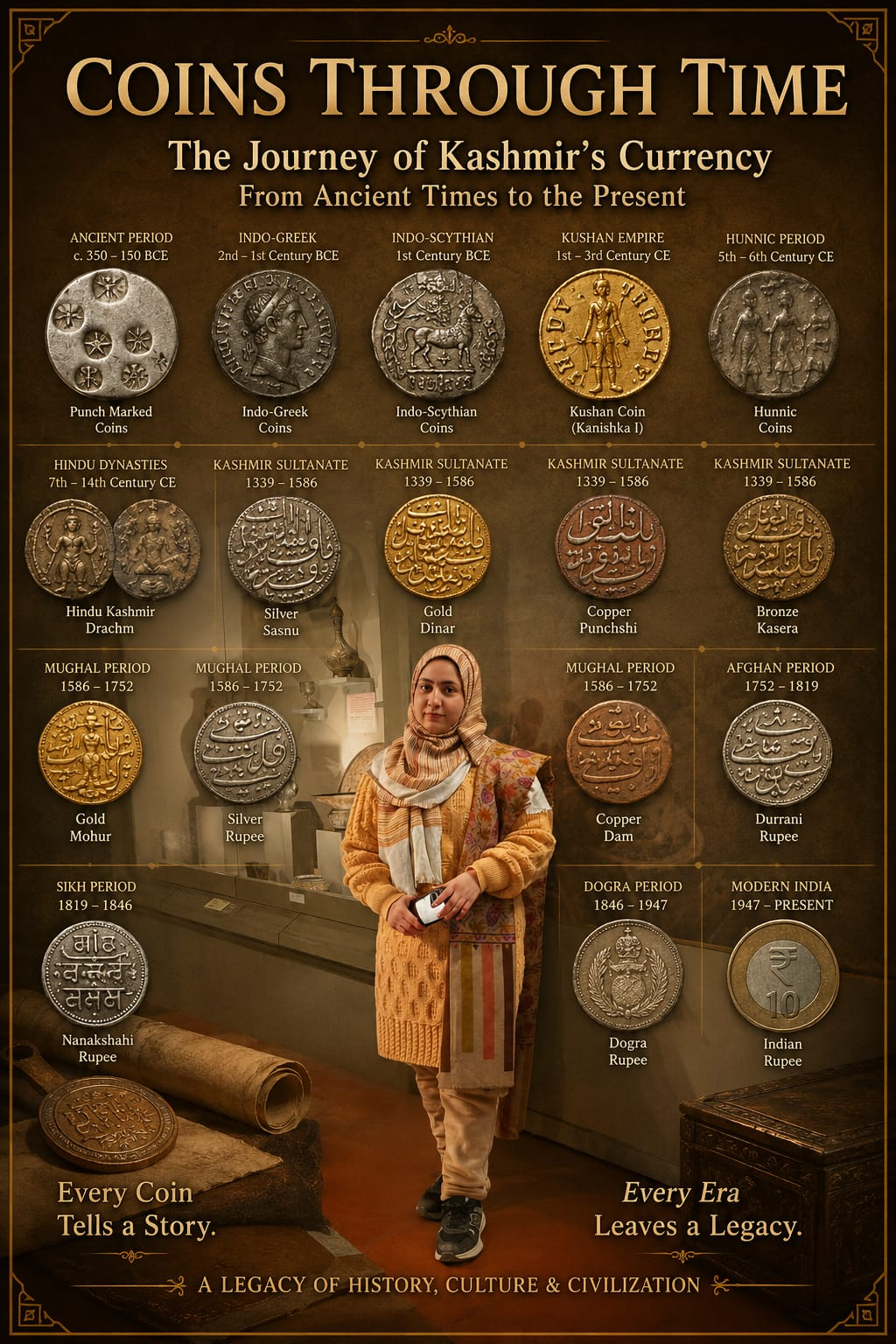
Long before paper currency, digital payments, and banknotes became part of everyday life, the people of Kashmir relied on coins that carried far more than monetary value. They bore the symbols of kingdoms, the names of rulers, the influence of religions, and the marks of cultures that flourished across centuries. Every coin that has passed through Kashmir's hands is a silent witness to its remarkable history.
The journey of Kashmir's currency began over two thousand years ago with simple punch-marked silver and copper coins. These early coins, stamped with small symbols instead of portraits, were among the first organized forms of money used in the region. They helped replace barter and encouraged trade, laying the foundation for a growing economy.
As history unfolded, Kashmir welcomed new rulers and new ideas. The Indo-Greeks introduced beautifully crafted coins featuring realistic portraits and Greek inscriptions, while the Kushan rulers transformed coinage into works of art. Under Emperor Kanishka I, coins displayed kings alongside gods and goddesses from different religious traditions, reflecting the rich cultural diversity of the time. These coins also remind us that Kashmir was once an important crossroads connecting South Asia, Central Asia, and beyond.
The Hindu dynasties that followed created one of the most enduring coin designs in South Asian history. For centuries, their coins commonly featured a standing king on one side and a seated goddess on the other. This remarkable consistency reflected not only artistic tradition but also the political continuity that defined medieval Kashmir.
A new chapter opened in 1339 with the establishment of the Kashmir Sultanate. Persian inscriptions replaced earlier designs, and coins became expressions of Islamic art and calligraphy. Gold Dinars, Silver Sasnus, Copper Punchshis, and Bronze Kaseras circulated across the valley, supporting trade while symbolizing the authority of the Sultans.
The arrival of the Mughals in 1586 connected Kashmir to one of the world's greatest empires. Standardized Gold Mohurs, Silver Rupees, and Copper Dams made commerce more efficient and linked Kashmiri markets with cities such as Lahore, Delhi, Agra, and Kabul. Coins became symbols of economic integration as much as political power.
Later, Afghan, Sikh, and Dogra rulers each left their own imprint on Kashmir's monetary history. During Dogra rule, an important milestone was reached with the introduction of paper currency in the nineteenth century, marking the transition from a purely metallic economy toward a modern financial system.
Today, the Indian Rupee is the official currency used in Jammu and Kashmir. Yet the ancient coins preserved in museums, archaeological collections, and private holdings continue to speak across generations. They remind us that history is not found only in books or monuments—it can also be held in the palm of a hand.
For historians, archaeologists, and collectors, these coins are priceless records of Kashmir's political changes, artistic achievements, and economic development. For ordinary readers, they offer something equally valuable: a chance to connect with a shared heritage that stretches back more than two millennia.
In an age when money is increasingly digital and invisible, the old coins of Kashmir invite us to pause and remember that currency is more than a medium of exchange. It is a reflection of identity, culture, and history. Every coin carries a story, and together, they tell the extraordinary story of Kashmir itself.
In loving memory of Dr. Priya Ranjan: A mentor who treated me like family

I will always remember Dr. Priya Ranjan not only as the Chairman of JK Monitor, but as a mentor, guide and elder brother whose kindness profoundly shaped my life and work. Write a tribute at In Loving Memory · Dr. Priya Ranjan
When he appointed me Editor-in-Chief of JK Monitor, he never treated me as an employee, but as a younger brother, offering warmth, trust, respect and invaluable guidance. I will always be grateful for his faith in me, his encouragement and the lessons he shared.
Dr. Ranjan was a rare and noble soul—humble, compassionate, intellectually brilliant and always willing to help others. A visionary thinker, he believed in using knowledge and abilities to make a meaningful difference. His influence lives on through the people he guided, the work he inspired and the countless lives he touched.
For me, he will always be the elder brother who believed in me and guided me with affection. I will cherish his kindness and lessons forever. May his soul rest in eternal peace. He will be deeply missed and never forgotten.
(Ajmer Alam Wani)
