

 Share your story and shine at JK Monitor!🌟 Welcome to JK Monitor, where every story matters and every achievement is celebrated! We invite you to share the remarkable journey of your life and showcase your accomplishments to the world. Join our exclusive interviews that honor exceptional individuals just like you.
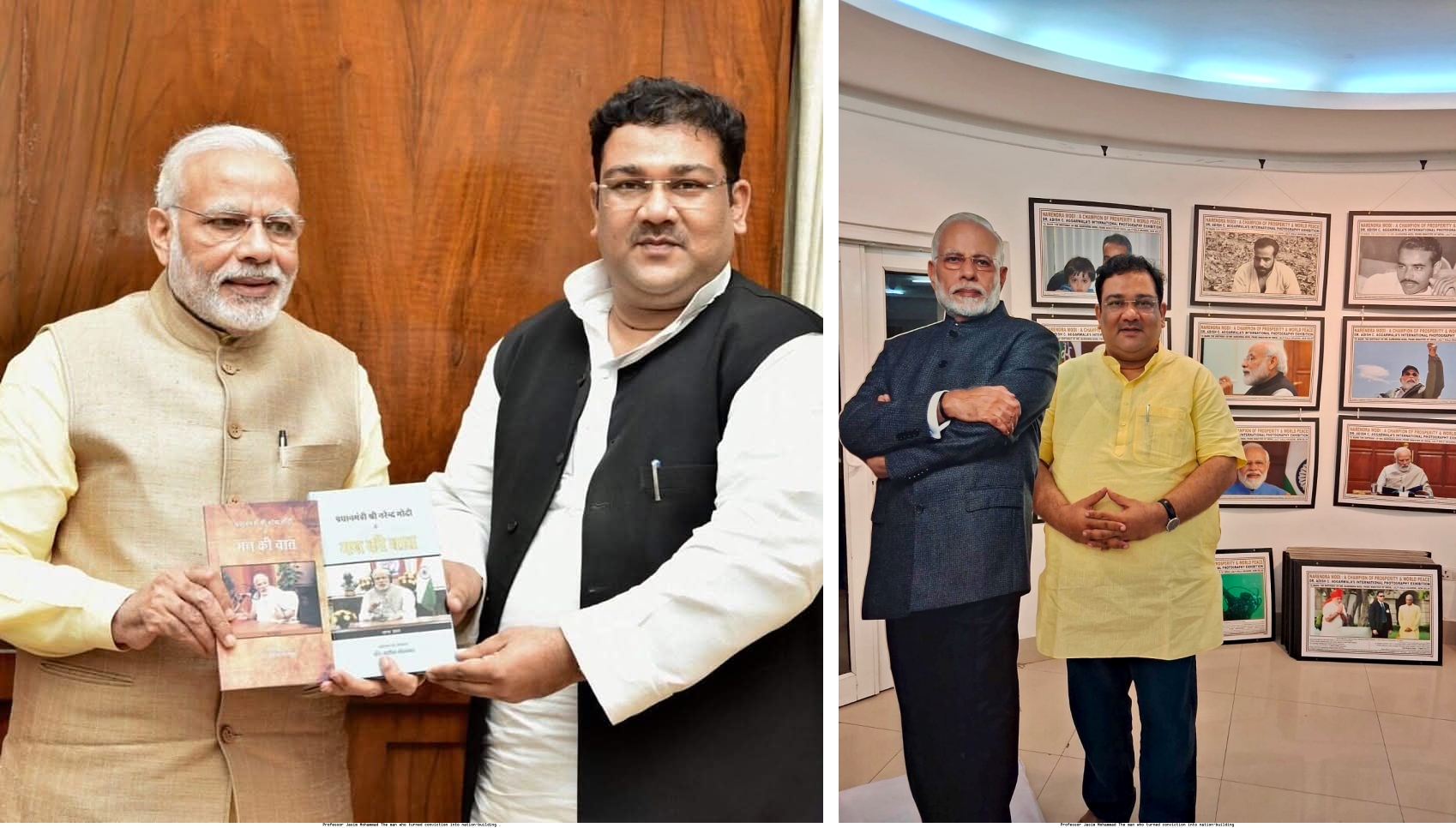
- Prof. Jasim Mohammad and his journey towardsa Viksit Bharat
 Some people spend their lives talking about change. Some write about it. And then there are those who quietly put their own time, money and reputation behind an idea and try to build something that lasts. Prof. Jasim Mohammad belongs to the third category. His most visible contribution in recent years has been the Centre for NaMo Studies (CNMS), a non-profit, independent research trust that he founded in Aligarh in 2016 and has gradually developed into a platform for academic dialogue, research and national engagement.
The story of Prof. Jasim Mohammad and CNMS cannot really be told separately. The Centre carries his intellectual conviction, his organisational energy and, perhaps most importantly, his willingness to take personal responsibility for an idea. When Prof. Jasim decided to establish the Centre on September 17, 2016, there was no large government grant waiting for him and no established institutional machinery to support the initiative. He had to begin almost from the ground up, working with limited resources and building the Centre's structure, network and programmes step by step.
There was also no certainty about how such an independent research initiative would develop or whether it would be able to sustain itself over the years. He went ahead nevertheless, driven by the belief that India needs institutions where ideas can be discussed seriously and where knowledge can contribute to the country's progress.
He imagined it as a research and dialogue platform where scholars, academics, students, professionals and public intellectuals could come together to discuss India's changing political, social, economic and cultural landscape. The idea was to study governance and development through multiple disciplines and to connect academic discussion with the larger national conversation.
The personal commitment behind the Centre is perhaps best illustrated by what Prof. Jasim was willing to give up to build it. To establish the Centre for NaMo Studies in Aligarh, he sold a parcel of ancestral land in his native Ghazipur, Uttar Pradesh. It is a detail that says more about his relationship with the institution than any formal profile could. He put his own resources into creating a physical space where the idea could take shape.
There was a certain symbolism in choosing Aligarh. Education, discussion, and reforms have always been linked with the city on account of the tradition of Sir Syed Ahmad Khan and Aligarh Muslim University. Prof. Jasim, himself associated with the university's academic world, saw Aligarh as an appropriate place to begin a conversation about contemporary India. He wanted the Centre to function in an environment where different intellectual traditions could meet and where questions about India's future could be discussed openly.
Over the years, the scale of his ambition became increasingly visible. Prof. Jasim began bringing eminent academics, educators, researchers and professionals to CNMS programmes. National seminars became a recurring feature of the Centre's work. The subjects expanded from governance and leadership to education, women-led development, technology, artificial intelligence, Indian Knowledge Systems, culture, language and national development. Organising a national seminar may appear simple from the outside: a stage, a banner, a few distinguished speakers and an audience. Behind that two-hour programme, however, are weeks and months of correspondence, invitations, travel arrangements, venue coordination, research, publicity, finances and follow-up. Prof. Jasim has repeatedly taken on this organisational burden to keep the Centre active.
His vision for CNMS has also evolved with the changing priorities of India. When artificial intelligence began transforming education and public life, the Centre opened discussions around AI and education, ethics, governance, Indian languages and Indian Knowledge Systems. When education reform became a major national conversation, CNMS organised programmes around the implementation of the National Education Policy 2020. When the discussion shifted towards India's cultural strength, the Centre organised programmes on cultural innovation and India's civilisational heritage.
This ability to connect the Centre's activities with contemporary national conversations has become an important part of Prof. Jasim's institutional approach. His programmes have repeatedly brought together education, culture, technology, language, social empowerment and knowledge systems. For him, the idea of a Viksit Bharat is connected with the confidence of a society in its own intellectual and cultural resources.
There is another dimension to Prof. Jasim's work that is easy to miss: his sustained interest in language and culture. His engagement with Urdu, Indian literature and cultural studies has found space within the activities of CNMS. Programmes dealing with Indian languages, Urdu and Indian Knowledge Systems demonstrate his belief that national development should not come at the cost of India's linguistic diversity. The most remarkable aspect of Prof. Jasim Mohammad's story is that he build CNMS without any government funding the foundation of its existence. He has repeatedly carried the financial and organisational responsibility himself. Nearly a decade after its establishment, CNMS has become the most visible institutional expression of Prof. Jasim Mohammad's conviction. From a modest beginning in Aligarh, it has grown into a platform for national seminars, academic discussions, youth programmes, cultural initiatives and collaborations with educational institutions. What cannot be overlooked is the persistence of his effort. In his own way, Prof. Jasim Mohammad has chosen to participate in Rashtrinirman by trying to build a platform through which others can discuss, question and contribute to that national journey.
(Author is Professor in Cyber Security and Chairperson of Divye Foundation New Delhi)

