

 Share your story and shine at JK Monitor!🌟 Welcome to JK Monitor, where every story matters and every achievement is celebrated! We invite you to share the remarkable journey of your life and showcase your accomplishments to the world. Join our exclusive interviews that honor exceptional individuals just like you.
- How a high-altitude Himalayan Lake weaves together myth, ecology, and the emotional fabric of a mountain community
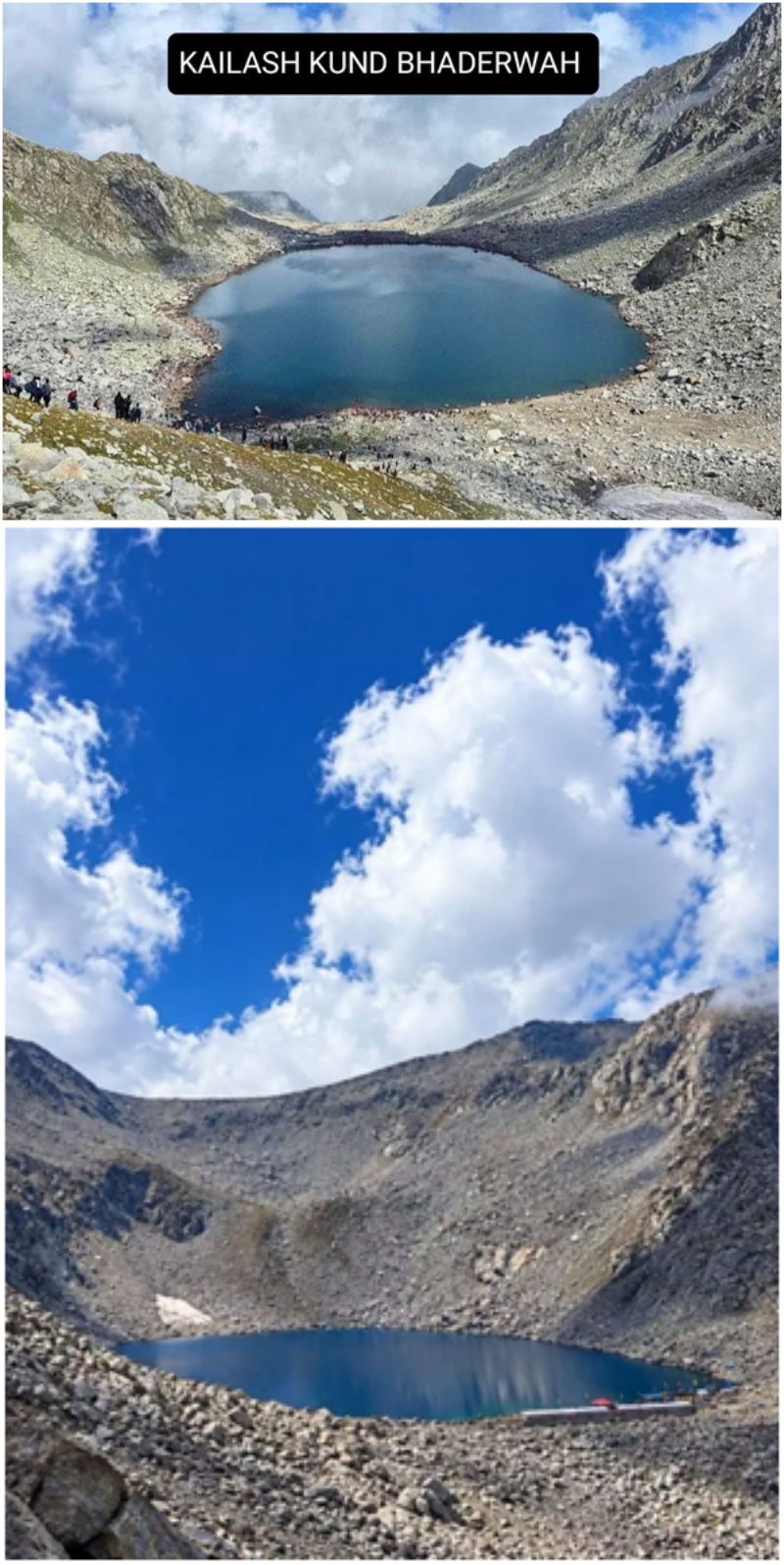 On the morning of September 8, 2026, as the first rays of sunlight grazed the folds of the Himalayas, the village of Gatha in the Bhaderwah Valley was already astir. Before the ancient Vasuki Nag temple, which traces its origins back two thousand years, the Charri Mubarak — the sacred staff — was ceremoniously brought out amid the beat of drums and the chanting of hymns. Thousands of pilgrims thronged around it and set off on the rugged mountain trail leading to Kailash Kund, perched at an altitude of 14,700 feet.
This is the Kailash Kund Yatra — one of the oldest and most arduous pilgrimages in North India. Three days, twenty-one kilometers of mountain trail, ascending from the temperate woodlands of the Bhaderwah Valley to the barren scree and glacial moraines above the treeline. The pilgrims carry their belongings on their backs, but they also carry a question that has endured for thousands of years: Why does a remote high-altitude lake compel generation after generation to endure cold, altitude sickness, and exhaustion, year after year, to walk toward it?
A Lake with Three Identities
Kailash Kund lies quietly above the town of Bhaderwah in Doda District, at the foot of the mountain locally known as Kablas. The water is clear and ice-cold, the lake about 1.5 miles in circumference, ringed by glaciers and bare rock. To an outsider, it is a landscape. To the people of Bhaderwah, it is the center of the universe.
The Mythological Dimension. According to the local Vasuki Puran narrative, Kailash Kund was originally the abode of Lord Shiva. Later, the serpent deity Vasuki Nag — the guardian deity of Bhaderwah — fled to this place to escape a conflict with Garuda, the eagle king. Shiva granted these waters to Vasuki and himself relocated to Manimahesh in Himachal Pradesh. Every place name along the pilgrimage route is a footnote to this myth: Gow Paeda (the path of the cow) is named for Vasuki climbing in the form of a cow; above the village of Nalthi lies the serpent's head; the villages of Bheja and Mathola carry his left and right arms respectively; his torso stretches across Nagar; and his feet rest at Gatha. The entire Bhaderwah Valley, on the map of faith, is a coiled serpent.
The Historical Depth. The Vasuki Nag temple at Gatha is believed to be two thousand years old. The timing of the annual pilgrimage is determined by the Vedic calendar — Krishan Paksh Dwadshi in the month of Bhadu, which usually falls in late August or early September. This timing is itself a historical testimony: it is older than modern nation-states, more enduring than roads and administrative boundaries.
The Ecological Sensitivity. Kailash Kund and the surrounding Seoz Dhar meadows constitute a rare alpine ecosystem in the western Himalayas. In 2023, India's National Green Tribunal admitted a petition seeking to declare the Kailash Kund-Seoz Dhar area a protected zone and to prohibit road construction, on the grounds that road-building would cause irreversible harm to local flora and fauna. The case remains unresolved, reflecting a deep tension between development and conservation.
The Pilgrimage Route: From Valley to Cloud
The Kailash Kund Yatra route is itself a three-dimensional local chronicle.
Pilgrims set out from the Vasuki Nag temple at Gatha. The sacred staff meets another Charri at the Vasak Dera temple — the "Milan" (meeting) ritual is considered the most moving moment, believed by devotees to concentrate the blessings of the entire valley. The procession ascends along the path by which Vasuki once fled, passing through Kali Nag, Hayan, Gan Thak, Gow Paeda, Ramtund, and Shankh Padar, before finally reaching Kailash Kund.
The first night is spent at Hayan (Nalthi), the second at Ramtund or the Seoz Dhar meadows. For pilgrims, this is a trial of both body and will. The altitude climbs abruptly from about 5,000 feet to 14,700 feet; oxygen is thin, and the weather changes by the hour. Yet it is precisely this hardship that gives the pilgrimage its meaning — as Manu Kotwal the daughter of main priest at Vasuka Naag Temple, put it, devotees firmly believe that the icy waters of Kailash Kund carry the healing properties of alpine medicinal herbs, capable of curing bathers of numerous ailments.
Upon reaching the lakeshore, pilgrims perform traditional rituals and then plunge into the freezing water. That plunge is the ultimate test of the body and the ultimate affirmation of faith.
Ecological Fragility and the Intervention of Law
The ecological value of Kailash Kund extends far beyond its religious symbolism.
The Seoz Dhar meadows stretch for miles at an altitude of about 11,000 feet and are considered among the largest meadows in Jammu and Kashmir. The trekking route passes through coniferous forests of pine, fir, and cedar, with wildflowers — purple, blue, red, and white — carpeting the slopes from August through September. From the meadows, the twin snow peaks of Brahma I and Brahma II stand imposingly in view. Although wildlife activity in this region is not documented in detail in the available sources, the National Green Tribunal case itself demonstrates that the area's biodiversity is deemed worthy of legal protection.
Yet a structural tension exists between ecological fragility and the scale of the pilgrimage. In 2016, more than twenty thousand pilgrims gathered at Kailash Kund. Although the pilgrimage itself lasts only three days and is traditionally confined to a specific period, the pressure for road construction has never subsided. The Bhaderwah Development Authority and local governments have long sought to improve access to the lake, while environmentalists warn that once a road is built, this last remaining pristine sanctuary will face irreversible change.
The 2023 tribunal case is a direct product of this contradiction. The petitioner, R.D. Singh Bandral, sought to have the Kailash Kund-Seoz Dhar area declared a protected zone and to prohibit road construction. The tribunal issued notices to the Public Works Department and Bhaderwah forestry officials. The final outcome will determine whether Kailash Kund remains a sacred mountain that must be measured on foot, or becomes yet another tourist destination accessible by car.
Vasuki Nag: The Guardian Deity of a Valley
To understand the Kailash Kund Yatra, one must ultimately understand what Vasuki Nag means to the people of Bhaderwah.
Vasuki is not a distant mythological figure. He is a neighbor, an ancestor, the final arbiter of justice. The inner sanctum of the Gatha temple is not open to women, as it is believed to be the dwelling of Vasuki's family. In the Vasuki Puran, Shiva himself tells Parvati that this is the greatest pilgrimage site in North India. During the annual pilgrimage, devotees from Dudu, Basantgarh, Himachal Pradesh, Jammu, Kathua, Udhampur, Chenani, and Ramnagar each carry their own Charri, converging on Kailash Kund along different routes. The meeting of these Charris is not merely ritual; it is the annual reaffirmation of a cultural community.
For the Bhaderwah diaspora — those who have migrated to Jammu, Delhi, or farther afield — the Kailash Kund Yatra is a spiritual coordinate for homecoming. Wherever they may be, the call of the Bhadu-month pilgrimage remains valid.
Between Tradition and the Future
The 2026 Kailash Kund Yatra concluded on September 10, with the Charri Mubarak returning to Bhaderwah in the evening, welcomed by hundreds of devotees at Vasuk Dera. Year after year, this cycle has never been broken — not even during the darkest days of the pandemic, not even in years when cloudbursts forced authorities to cap the number of pilgrims on safety grounds.
But the future of Kailash Kund is not without its anxieties. Climate change is reshaping alpine ecosystems across the Himalayas — glacial retreat, shifting precipitation patterns, migrating vegetation zones. These macro forces will eventually reach this lake. The pressure of infrastructure persists. A younger generation of pilgrims may no longer be able to complete a high-altitude trek as their parents did, without medical oxygen and proper tents.
Yet it is precisely this hardship that gives the Kailash Kund Yatra a meaning that transcends religion in the contemporary context. In a world increasingly defined by speed and convenience, there are still those willing to spend three days walking to a lake at 14,700 feet, simply to bathe once in its icy waters. That act, in itself, is an answer to the question of what is worth pursuing.
The mountain people of Bhaderwah say that Vasuki Nag chose this valley as his abode. The Kailash Kund Yatra is the valley's annual response to that choice — measuring faith with footsteps, testing devotion with cold, and drawing, with a lake at its center, the spiritual circumference of a civilization thousands of years old.

