

 Share your story and shine at JK Monitor!🌟 Welcome to JK Monitor, where every story matters and every achievement is celebrated! We invite you to share the remarkable journey of your life and showcase your accomplishments to the world. Join our exclusive interviews that honor exceptional individuals just like you.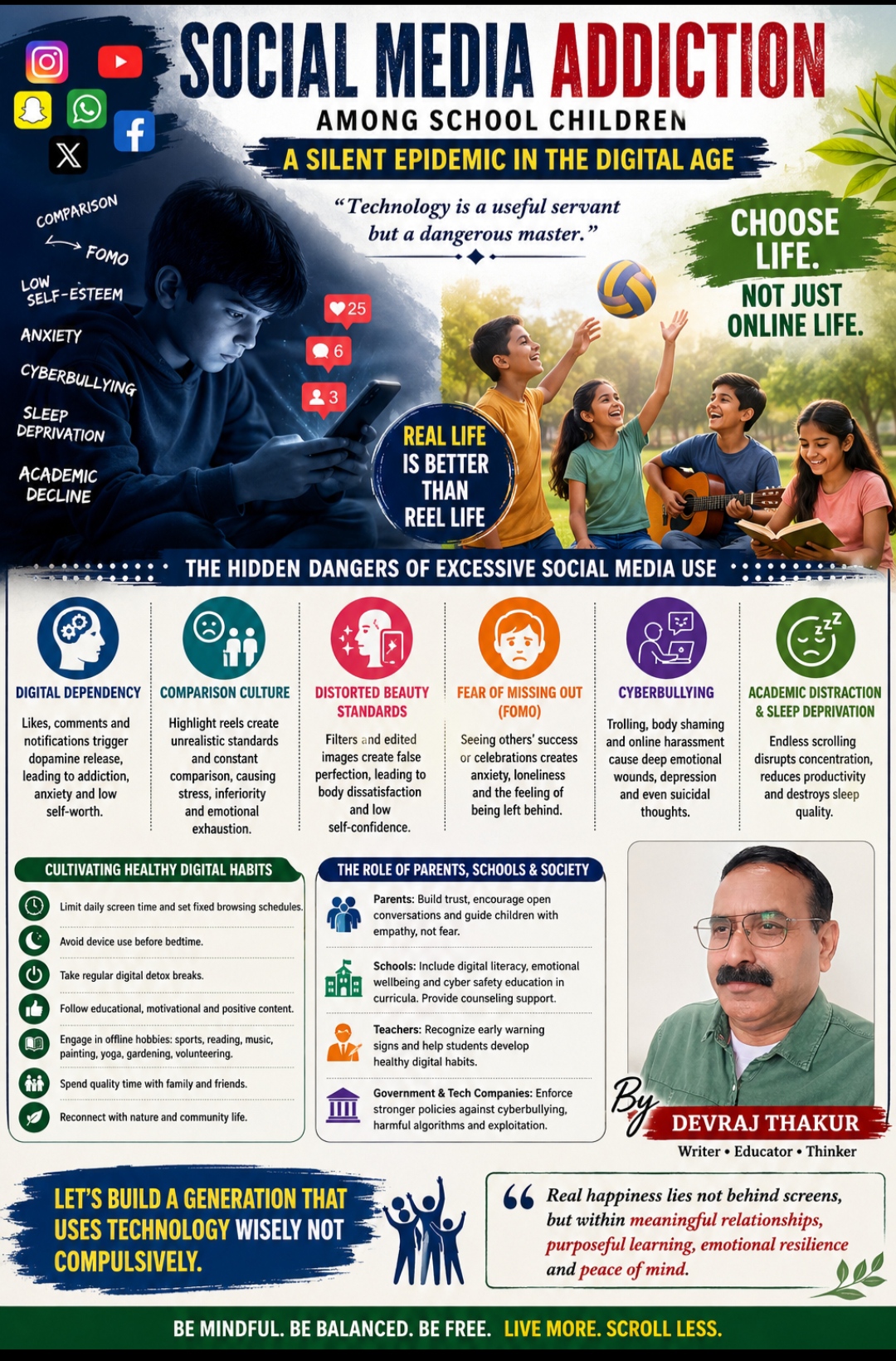
In the contemporary era, social media has woven itself into the fabric of everyday existence with such subtlety that its presence often goes unquestioned. What was once merely a technological innovation has now metamorphosed into a parallel universe where identities are curated, emotions are commodified, and attention has become the new currency. For school-going children, particularly adolescents navigating the fragile corridors of identity formation, social media has emerged as both a boon and a bane—a double-edged sword that cuts both ways.
India, with its rapidly expanding digital ecosystem, affordable smartphones, and inexpensive internet connectivity, has witnessed an unprecedented surge in internet penetration. Today, children in both urban metropolises and rural hamlets are equally exposed to platforms such as Instagram, YouTube, Snapchat, WhatsApp, and Facebook. While these platforms undeniably offer opportunities for learning, networking, and creative exploration, their excessive and unregulated use has given rise to a disturbing phenomenon—social media addiction.
The Psychology Behind Digital Dependency
Social media platforms are meticulously engineered to capture and retain user attention. Every notification, like, comment, and share acts as a micro-reward, stimulating the release of dopamine—the neurotransmitter associated with pleasure and gratification. For children, whose neurological and emotional frameworks are still under development, this intermittent reinforcement becomes dangerously habit-forming.
A student posting a photograph or academic achievement online may experience fleeting happiness upon receiving positive feedback. However, in the absence of expected engagement, the same child may encounter feelings of inadequacy, rejection, and diminished self-worth. Thus begins a vicious cycle where external validation replaces internal confidence.
This digital dependency mirrors behavioral addictions in many respects. Compulsive checking of phones, inability to disengage from screens, irritability during device deprivation, and anxiety over missed notifications are increasingly common symptoms among school children. What begins as casual scrolling often snowballs into an all-consuming habit.
Comparison Culture and the Crisis of Self-Worth
Social media, by design, showcases life through a carefully polished lens. Users rarely post their struggles, failures, or insecurities; instead, they broadcast achievements, celebrations, vacations, and aesthetically curated moments.
For impressionable school children, constant exposure to these “highlight reels” fosters a culture of relentless comparison. A student may begin to believe that peers are academically superior, socially more accepted, or physically more attractive.
This phenomenon is particularly pronounced in India’s highly competitive educational environment, where academic performance, extracurricular excellence, and social standing are often magnified under societal scrutiny. The result is heightened anxiety, inferiority complexes, and emotional exhaustion. As the adage wisely states, “Comparison is the thief of joy.” Unfortunately, in the digital world, children are encouraged to compare not occasionally, but incessantly.
Distorted Beauty Standards and Body Image Concerns
Platforms dominated by visual content have normalized unrealistic beauty standards through filters, photo-editing applications, and carefully staged imagery. Skin-smoothing effects, facial modifications, and body-enhancing filters create an illusion of unattainable perfection.
Young school children, particularly adolescents, often internalize these distorted standards and develop dissatisfaction with their natural appearance. This may manifest as low self-esteem, body image disturbances, unhealthy dieting behaviors, and emotional distress.
The growing obsession with cosmetic enhancement and appearance-based validation among Indian youth is symptomatic of a deeper psychological malaise fueled by digital culture.
Fear of Missing Out (FOMO): The Anxiety of Exclusion
One of the most pervasive psychological consequences of excessive social media use is Fear of Missing Out (FOMO). School children observing peers attending social gatherings, excelling in competitions, or celebrating milestones may develop the irrational belief that they are lagging behind in life.
This creates chronic anxiety, loneliness, and dissatisfaction. Children in smaller towns or rural areas may feel particularly vulnerable when comparing their lived realities with the seemingly glamorous lifestyles of metropolitan peers. Thus, even in moments of real-world contentment, digital exposure can sow seeds of emotional unrest.
Cyberbullying: The Invisible Wound
Social media has also amplified the reach and intensity of bullying. Unlike traditional bullying confined to physical spaces, cyberbullying infiltrates the safety of home and operates round the clock.
School children today face trolling, rumor propagation, body shaming, character assassination, and abusive commentary. Victims often endure these psychological assaults in silence, fearing embarrassment or parental restrictions.
The emotional repercussions are profound—stress, social withdrawal, depression, academic decline, and in extreme cases, self-harm ideation. Parents and teachers frequently remain oblivious to this hidden suffering, making early intervention imperative.
Academic Distraction and Sleep Deprivation
Perhaps the most immediate casualty of social media addiction is academic discipline. Endless scrolling, binge-watching short videos, and compulsive messaging significantly erode concentration spans.
Students increasingly struggle to sustain attention during studies, complete assignments on time, or retain information effectively. Late-night device use further compounds the issue by disrupting melatonin production and sleep cycles.
The epidemic of “doomscrolling” among adolescents has transformed bedtime into screen time, resulting in sleep deprivation, irritability, reduced cognitive efficiency, and emotional instability. Indeed, burning the midnight oil has acquired an entirely different meaning in the smartphone era.
The Role of Parents, Schools, and Society
Addressing social media addiction cannot be reduced to individual willpower alone; it necessitates collective responsibility. Parents must cultivate open dialogue rather than resorting solely to surveillance or prohibition. Children should feel comfortable discussing online experiences, peer pressures, and digital anxieties without fear of judgment.
Schools must incorporate digital literacy, emotional intelligence, and cyber safety education into their curricula. Awareness workshops, counseling support systems, and sensitization programmes can empower students to navigate the digital landscape responsibly.
Teachers, often regarded as architects of the nation, must recognize early warning signs of digital addiction and behavioral changes. Government bodies and technology companies also bear ethical responsibility. Stricter regulation of harmful algorithms, enhanced child safety protocols, and robust anti-cyberbullying mechanisms are urgently needed.
Cultivating Healthy Digital Habits
School children should be encouraged to embrace mindful technology usage through practical measures:
Limiting daily screen time and establishing fixed browsing schedules
Avoiding device usage before bedtime
Taking regular digital detox breaks
Following educational and motivational content instead of toxic or comparison-driven pages
Engaging in offline hobbies such as sports, reading, music, gardening, painting, yoga, and community service
In rural India especially, reconnecting children with nature, family interactions, and community participation can act as a powerful antidote to digital saturation.
Conclusion
Social media is not intrinsically detrimental; its consequences are contingent upon the consciousness with which it is used. Like fire, it can illuminate or consume. For school children standing at the crossroads of emotional, intellectual, and social development, unregulated digital immersion poses serious risks to mental health and personality formation.
India, as one of the world’s largest digital societies, must urgently foster a culture of digital balance. The objective is not digital abstinence, but digital wisdom. After all, technology should remain a servant of human progress, not its master.
In an age obsessed with followers, filters, and fleeting validation, children must be reminded of a timeless truth: real happiness lies not behind screens, but within meaningful relationships, purposeful learning, emotional resilience, and peace of mind.
(The author Devraj Thakur is National Joint Secretary, Akhil Bhartiya Rashtriya Shakshik Mahasangh – Delhi India)- Contact @ drthakur868@gmail.com