

 Share your story and shine at JK Monitor!🌟 Welcome to JK Monitor, where every story matters and every achievement is celebrated! We invite you to share the remarkable journey of your life and showcase your accomplishments to the world. Join our exclusive interviews that honor exceptional individuals just like you.
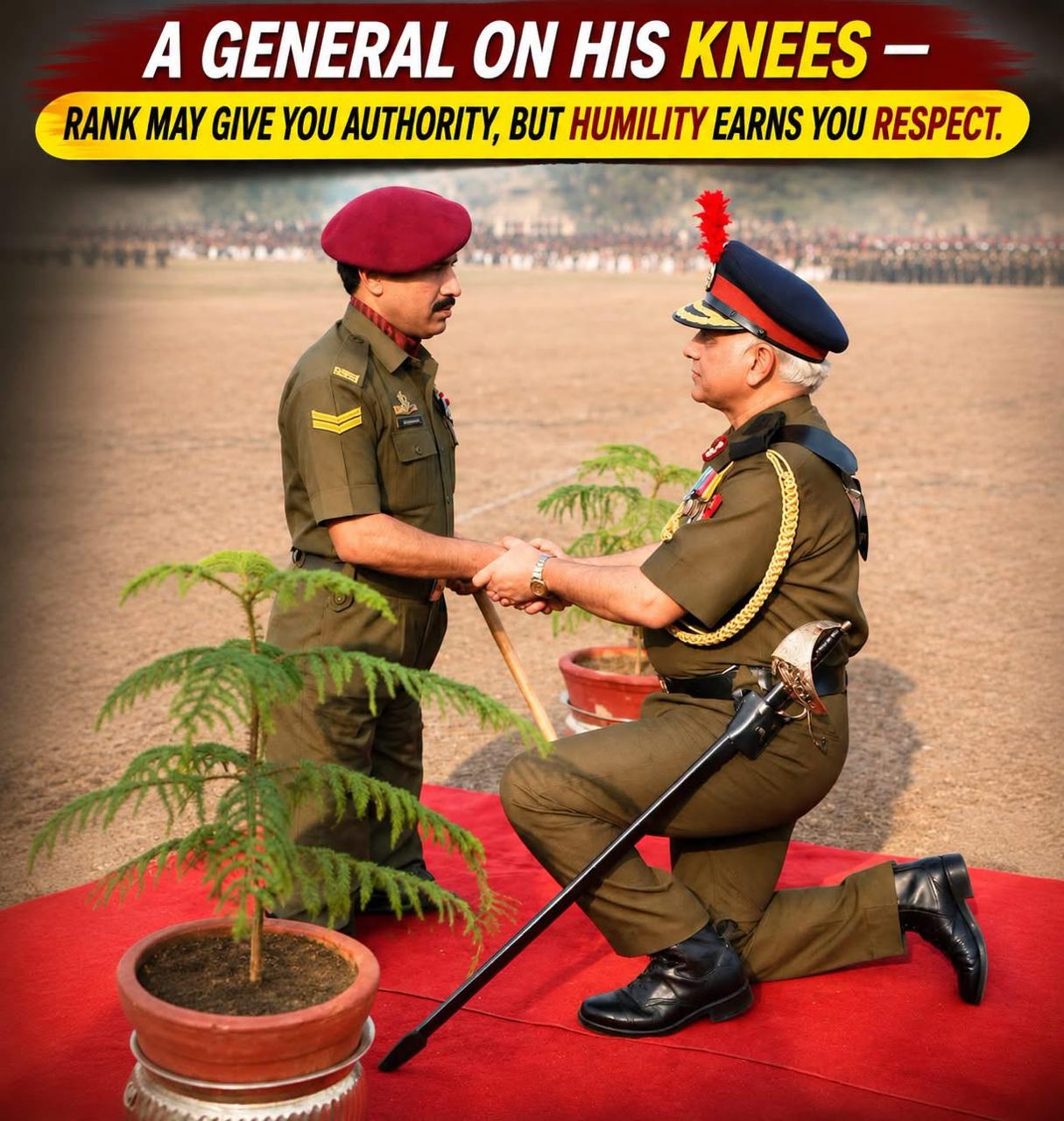
There are moments in history, captured in the silent click of a camera, that transcend the immediate event to become eternal lessons for humanity. They are not merely photographs; they are visual scriptures, teaching us about our own potential for grace, dignity, and profound moral courage. One such image, seared into the collective consciousness of our nation, is that of a three-star General on his knees. It is a picture that, at first glance, might seem to depict a scene of supplication. But look closer, and you will see it for what it truly is: a portrait of leadership in its most exalted, powerful, and purest form.
The photograph captures then Lieutenant General H. M. Khanna, General Officer Commanding-in-Chief of the Southern Command, at a solemn investiture ceremony. He is not standing tall, dispensing honour from a position of height and authority. Instead, he has descended from the formal pedestal of rank. He is kneeling on the stage, his posture lowered, to present the Sena Medal to Lance Naik Rajan Singh Mehra of 3 PARA. This was not a gesture of weakness. It was a display of such immense inner strength that it redefined the very concept of leadership for all who witnessed it.
To understand the gravity of this moment, we must first understand the story of the soldier receiving the honour. In 1996, Lance Naik Rajan Singh Mehra was a young man in the prime of his life, serving his nation in an encounter with terrorists. In the brutal firefight that ensued, he sustained severe injuries, wounds so catastrophic that they ultimately led to the amputation of both his legs. He sacrificed his limbs, his mobility, and the physical wholeness of his body on the altar of duty. His courage was not just a fleeting burst of bravery in the heat of battle; it is a courage he must now summon every single day of his life. The Sena Medal he was to receive was a token of the nation’s gratitude for a sacrifice that words can barely contain.
General Khanna, a man who commanded armies, who bore the weight of strategic decisions on his shoulders, understood the magnitude of this sacrifice. He could have, as is the custom, remained standing and leaned down to pin the medal on the soldier’s chest. Protocol would have permitted it. Rank would have demanded it. It would have been, by all standards, correct. But General Khanna chose to do something that was infinitely more than merely correct. He chose to do what was right.
He came down from his position of authority. He bent his knee and lowered his body until he was at the same eye level as the soldier he was honouring. In that single, fluid motion, he closed the chasm between a General and a Lance Naik, between the decorated and the decorator. He was not just presenting a medal; he was offering his personal, profound respect. He was acknowledging that the courage of this wounded warrior, seated before him, was a force so magnificent that it commanded the humility of a three-star general. With his act, he elevated the soldier's sacrifice above the trappings of his own rank.
This single gesture speaks volumes about the essence of true leadership. It reminds us that leadership is not a destination of power, but a journey of service. Rank may give you authority, the ability to issue commands and enforce discipline, but it is humility that earns you the unwavering respect and loyalty of those you lead. True leadership is not about how high you stand on the ladder of hierarchy; it is about how far you are willing to bend to honour the courage and contribution of others.
A great leader, like General Khanna, doesn't use their position to make others feel small. They do not hoard the spotlight or stand on a pedestal of self-importance. Instead, they use their platform to shine a light on the incredible work of their team. They understand that an organisation, an army, or a nation is not built on the strength of one individual, but on the collective dedication of many. Their role is to recognise, validate, and celebrate that dedication. They make every single individual feel seen, valued, and respected, no matter how junior their rank or how small their part may seem.
In the corporate world, in our institutions, and within our society, this lesson is desperately needed. We are often obsessed with the symbols of power—the corner office, the title on the door, the reserved parking spot. We mistake authority for leadership. We equate confidence with arrogance. General Khanna’s act provides a powerful antidote to this modern malaise. It shows that the most powerful person in the room doesn't need to shout; their actions speak with a force that echoes through time. The most confident leader is often the most humble, for they have nothing to prove to anyone but themselves.
This philosophy is a cornerstone of our work at Synergetic Green Warriors Foundation. We operate on the principle of servant leadership. We believe that to inspire change, to mobilise communities towards a sustainable future, the first step is not to command but to listen. The first step is not to dictate but to empower. We work on the ground with people, at their level, understanding their challenges and honouring their local knowledge. It is only through this humility—this willingness to learn from the very people we seek to serve—that we can build trust and create lasting, meaningful impact. We must kneel, metaphorically, in deference to the communities we work with, to their resilience and their wisdom.
The photograph of General Khanna and Lance Naik Mehra is not just a military anecdote. It is a universal template for leadership, applicable to a CEO, a teacher, a parent, or a community organiser. It teaches us:
1. Respect is Earned, Not Demanded: You can command attention with a title, but you can only command hearts with humility. Respect is a two-way street, and it is paved with acts of genuine appreciation.
2. Service Over Self: The true purpose of any leader is to serve a cause greater than themselves—the mission, the team, the nation. General Khanna’s focus was on the sacrifice of the soldier, not on the stature of his own position.
3. The Power of Seeing: The greatest gift a leader can give is the gift of being truly seen. In that moment, Lance Naik Mehra was not just another medal recipient; he was a hero, and his commander was showing him that he saw him, his pain, and his glory.
4. Leadership is Action: A thousand flowery speeches about respect and humility are worthless without a single action to demonstrate them. The power of this image lies in the physical act. It is leadership made visible.
As we look at this image, we are reminded of our own capacity for grace. It is a heartfelt salute to Lance Naik Rajan Singh Mehra (Sena Medal) and every soldier who has sacrificed their today for our tomorrow. But it is also a profound lesson for each of us.
Let us all strive to lead with such humility. Let us measure our worth not by the height of our standing, but by the depth of our character. For, in the end, the true height of a leader is not measured in inches or ranks, but in the boundless, beautiful measure of their humility. That is the highest form of leadership. That is the legacy that inspires generations. That is the power of a General on his knees.

